The find it game for dogs is one of the simplest ways to turn sniffing into a structured activity. You hide a safe food reward or familiar toy, give the cue, and let your dog use their nose to locate it.
The game does not require special equipment, a large home, or advanced obedience. It can work in one room, along a quiet section of a walk, or inside a supervised cardboard-box setup. The important part is not making the hiding place clever. It is setting a search your dog can solve without panic, conflict, or repeated help.
This guide explains how to teach find it from the first visible treat to more interesting scent searches, how to adjust it for different dogs, and when to stop.
What the find it game teaches
Find it gives a dog permission to perform several natural behaviors in an appropriate setting:
- sniffing and following odor
- foraging for food
- moving independently while staying connected to the handler
- solving a manageable problem
- shifting attention away from an unhelpful distraction
It can be a useful part of a broader dog enrichment routine, but it is not a cure for every behavior problem. A search game will not resolve pain, separation distress, serious guarding, or intense fear by itself.
The best sign that the activity suits your dog is not speed. Look for steady sniffing, a loose body, willingness to keep searching, and an easy return to normal activity afterward.
What you need before you start
For the first session, choose:
- a quiet room with a nonslip floor or stable rug
- three to eight tiny treats your dog can safely eat
- a clear release cue if your dog already knows one
- two or three minutes without interruptions
Use part of the dog's measured meal when practical. If your dog has allergies, a prescription diet, swallowing difficulty, pancreatitis, or another medical feeding concern, use only veterinarian-approved food.
Check the search area at dog level. Remove medication, children's toys, cords, sharp objects, open food containers, and anything your dog might swallow. Close access to trash cans and other rooms until your dog understands the boundaries of the game.
How to teach find it step by step
1. Start with a visible treat
Stand close to your dog in the quiet room. Say “find it” once, then place or gently toss one treat a short distance away where the dog can see it land.
Let the dog move to the treat. Avoid repeating the cue, pointing continuously, or rushing toward the food. At this stage, the sequence is simple: your cue predicts that searching for something nearby will pay off.
Repeat three or four times in different easy directions.
2. Use a partly hidden placement
Place the treat at the edge of a rug, beside a furniture leg, or just behind an open box flap while your dog watches. The treat can be out of direct view, but the route should be obvious.
Say the cue and wait. Give the dog several seconds to use their nose before helping. If the dog walks away or looks worried, reveal the treat and make the next repetition easier.
3. Let the dog search without watching the hide
Ask your dog to wait behind a baby gate, or have another person calmly hold the leash. Place one treat in an easy location, return to the dog, and say “find it.”
For the first unseen search, use a location the dog has already solved while watching. Familiarity keeps the new challenge focused on scent rather than a complicated room puzzle.
4. Expand the search area gradually
Once your dog understands the game, make one change at a time:
- place the treat a little farther away
- use two hiding places instead of one
- move from one side of the room to the whole room
- hide food partly under an open towel edge
- place a treat on a safe, low surface at nose height
Do not increase distance, height, number of hides, and environmental distraction in the same round. If a search fails, simplify immediately. Success teaches more than leaving the dog stuck.
5. Add a clear finish
After the last item is found, say a consistent phrase such as “all done”, show your empty hands, and move into a calm next activity. A finish cue prevents the dog from searching every corner indefinitely or continuing to forage for unsafe household items.
How difficult should the game be?
A useful search should contain some uncertainty but remain solvable. Watch how your dog works rather than judging difficulty by the hiding place alone.
The level is probably appropriate when your dog:
- begins searching after one cue
- uses the nose more than frantic pawing
- checks more than one location
- keeps a loose, comfortable body
- finds the item within a reasonable time
- can stop when the game ends
Make it easier if the dog barks at you for help, scratches destructively, starts grabbing random objects, leaves the area, or searches faster and more frantically with each repetition.
Confidence grows through a high rate of successful finds. Dogs do not need to “fail until they figure it out.”
Indoor find it variations
Room scatter
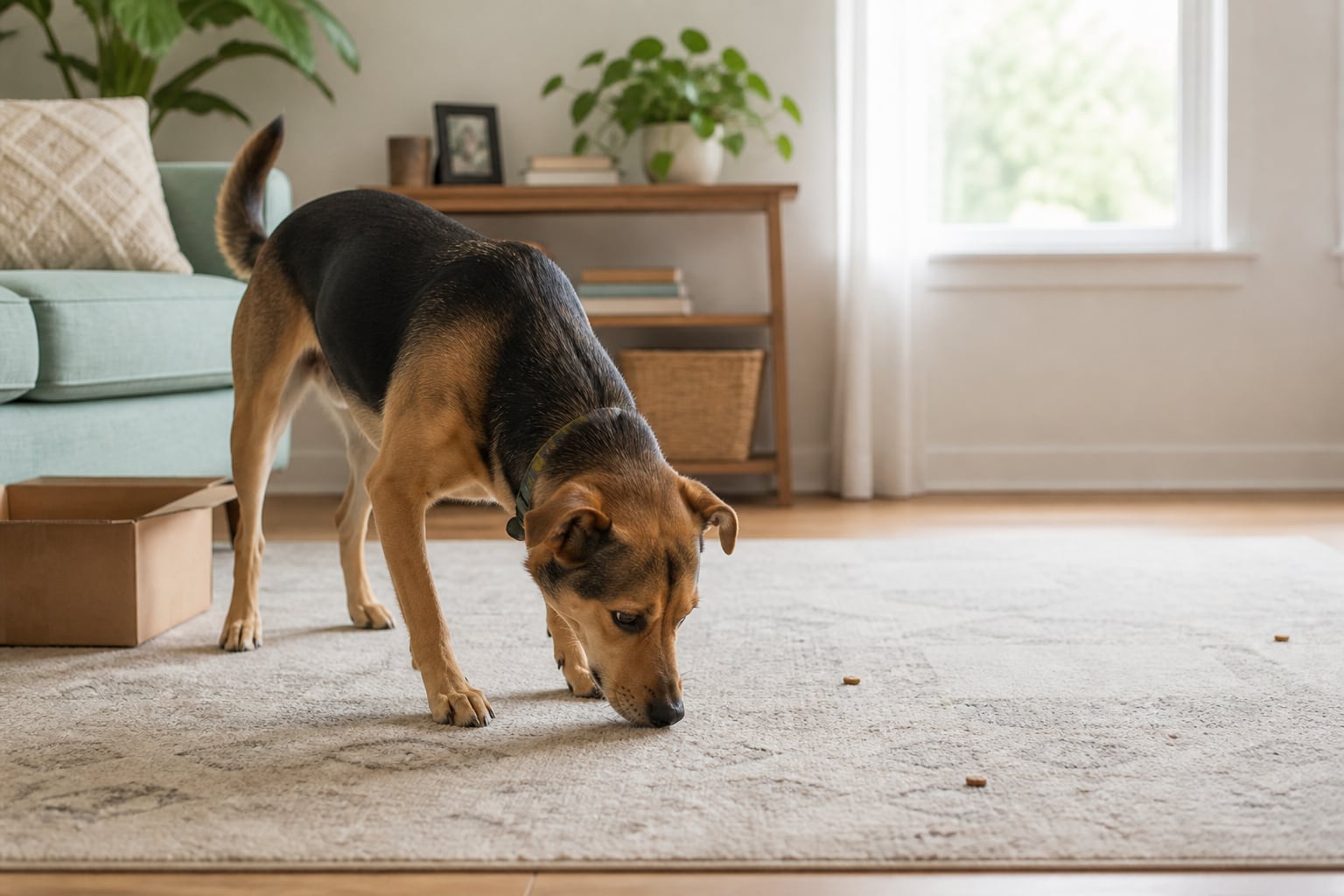
Place several pieces of food across an open room while the dog waits outside. Keep the pieces far enough apart that the dog must sniff between them. Count the pieces so you know when the search is complete.
Towel folds
Lay a towel flat and place food beside one or two loose folds. Do not knot the towel or bury food deeply for a beginner. Supervise closely and remove it if the dog begins tearing or swallowing fabric.
Box search
Put one treat in an open box among two empty open boxes. Use stable boxes without staples, tape loops, plastic packing material, or food residue. Dogs that enjoy shredding may prefer the separate safety plan in cardboard box enrichment for dogs.
Toy search
Let your dog watch you place a favorite toy partly behind a chair. Say “find it,” then reward the discovery with a short game. Increase difficulty only when the dog searches for the toy rather than waiting for food.
Family-member search
One person hides in an easy, safe location while another releases the dog. The hidden person can call once at the beginner level, then reward the find with calm praise or play. Never hide where the dog must jump, climb, or push through a closed space.
Taking find it outdoors
Outdoors adds wind, wildlife odor, traffic, and a much larger search area. Return to obvious placements when you change environments.
On a quiet walk, place one treat in short grass while your dog watches, say the cue, and allow a brief search on a standard leash. Avoid tossing food near roads, broken glass, unknown plants, animal waste, or places where other dogs may guard food.
For dogs that react to triggers, find it can sometimes help lower the head and redirect attention, but timing matters. Use it before the dog is overwhelmed and only when the dog can safely eat. If your dog is barking, lunging, frozen, or unable to take food, create distance instead. The reactive dog threshold guide explains how to recognize when learning is still possible.
Do not scatter food when an unfamiliar dog is approaching closely. Move away first so the dog can search without defending food or being surprised.
Adjusting the game for different dogs
Puppies
Keep sessions under a few minutes and make every location obvious. Puppy-proof the room first, because a young dog may investigate the hiding container instead of the food. Use part of the normal ration and supervise every search.
Senior dogs
Use nonslip flooring, wide routes, and floor-level hides. Avoid repeated stairs, tight turns, and placements that require stretching or crouching. Dogs with vision or hearing loss may still enjoy scent work, but sudden difficulty changes can be confusing.
Sighthounds and fast movers
Place treats rather than throwing them across slippery floors. The goal is controlled searching, not sprinting after visible food.
Scenthounds and highly experienced searchers
Increase the search area before making individual hides inaccessible. A larger simple search often provides more satisfying nose work than a tiny, frustrating puzzle.
Multi-dog homes
Work with one dog at a time behind secure barriers. Even dogs that normally share well can compete when food is hidden. Separate searches also let you match difficulty to each dog.
Common find it mistakes
Repeating the cue continuously
Say the cue once and allow time to work. Constant talking can make the dog look to you instead of following scent.
Pointing to every answer
Helping occasionally is fine, but repeated pointing turns the game into following your hand. If the dog needs help on most searches, reduce the area or reveal more of the item.
Hiding food where the dog should never forage
Do not use countertops, dining tables, trash areas, medication storage, bags, or children's belongings. Search locations teach habits, so choose places where investigation is safe and acceptable.
Making every round harder
Mix easy and moderate searches. An easy final find helps the session end successfully, especially after a difficult attempt.
Forgetting the calories
Tiny pieces add up. Measure the search food before the session and account for it in the dog's daily intake.
Continuing after the dog is finished
Stop if the dog disengages, pants without physical exertion, becomes frantic, guards the search area, chews containers, or appears tired. Enrichment should remain voluntary and safe.
When not to use food searches
Pause and ask a veterinarian or qualified behavior professional for guidance if your dog:
- guards scattered food from people or animals
- eats nonfood objects during searches
- has a medical diet that cannot be divided safely
- becomes panicked when unable to find an item
- has sudden changes in appetite, smell ability, mobility, or behavior
For dogs that cannot use food, a familiar toy or a short person-search may work, but only if those rewards do not create guarding or unsafe excitement.
A simple seven-day progression
You do not need to follow a rigid program, but this example keeps difficulty changes small:
- Day one: five visible treat tosses in one quiet room.
- Day two: five treats placed beside easy landmarks while the dog watches.
- Day three: three partly hidden placements at floor level.
- Day four: one unseen hide in a familiar location, repeated three times.
- Day five: two unseen hides across half the room.
- Day six: a simple open-box search with one food box and two empty boxes.
- Day seven: one easy outdoor search in clean short grass.
Repeat a level whenever the dog needs it. Progress is the dog's ability to search calmly and finish comfortably, not the number of days completed.
FAQ
How do you teach a dog the find it game?
Say “find it” as you place or toss one treat where your dog can see it. After several easy successes, use partly hidden placements, then let the dog search for one simple hide they did not watch you make.
Is find it good enrichment for dogs?
Yes. It provides sniffing, foraging, movement, choice, and problem solving in a small space. Match the challenge to the dog's experience and stop before searching becomes frustrating.
Can puppies play find it?
Yes, with very easy hiding places, measured puppy-safe food, a puppy-proofed search area, and close supervision.
Can I use a toy instead of treats?
Yes. Start with a favorite toy partly visible and reward the find with a brief play session. Avoid this variation if the toy causes guarding or frantic behavior.
How long should the game last?
A few minutes is often enough. End after the planned finds or sooner if the dog loses interest, becomes tired, chews the setup, or searches frantically.
Why can my dog not find the treat?
The area may be too large, the hide may be too difficult, or the dog may not understand the cue yet. Reveal the item, shrink the search area, and return to visible placements.