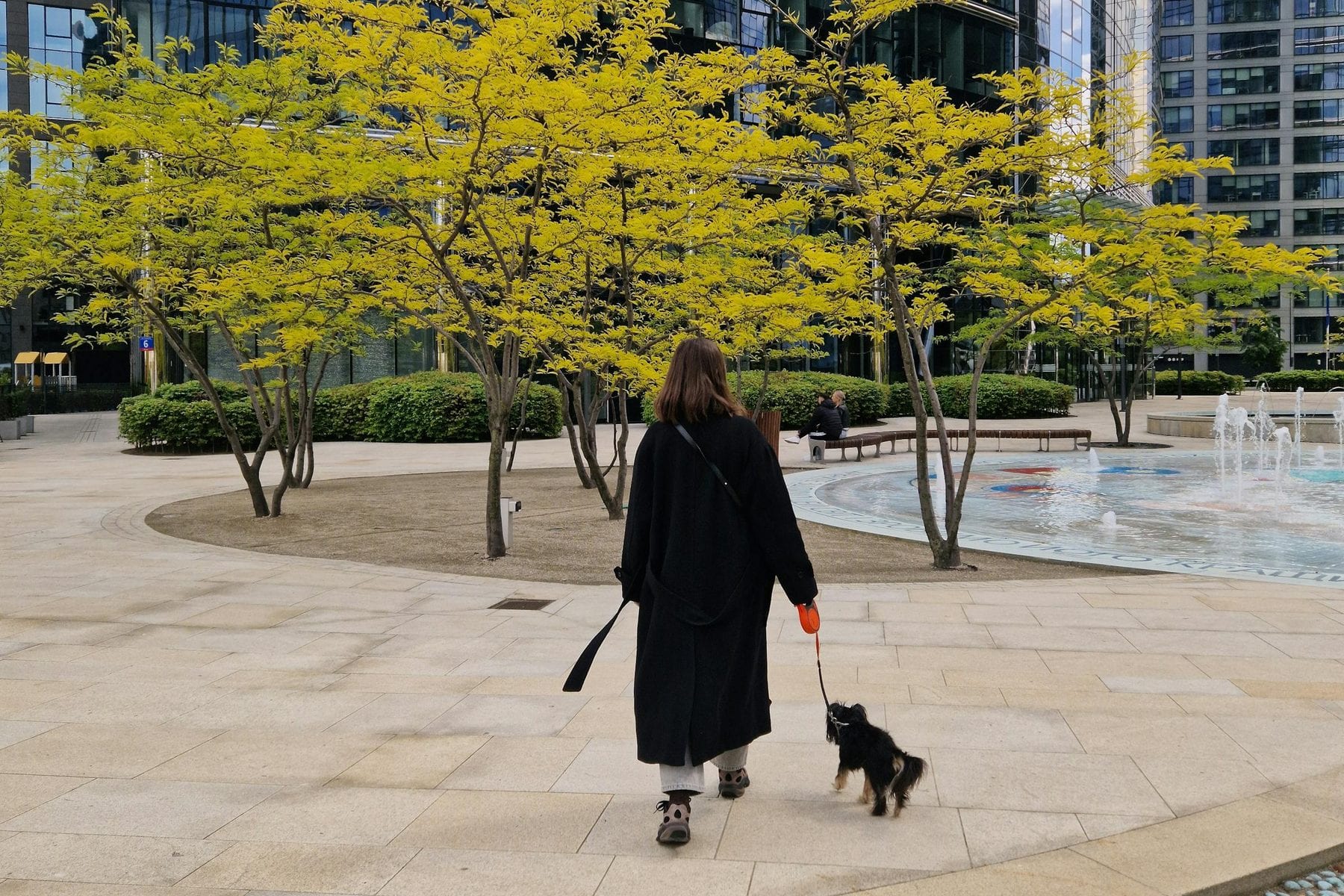
When summer temperatures climb, dog owners often want one simple number: How hot is too hot to walk a dog?
The honest answer is that there is no single safe cutoff for every dog. An air temperature that feels manageable on a dry, shaded morning may become dangerous in direct sun, high humidity, still air, or on heat-soaked pavement. A young, lean, healthy dog may also handle conditions differently from a flat-faced, older, overweight, thick-coated, or medically vulnerable dog.
That does not mean you have to guess. You can make a safer decision by checking five things before leaving:
- air temperature and humidity
- sun, shade, and airflow
- pavement and route conditions
- your dog's individual risk
- the planned pace and duration
This guide gives you a practical way to decide whether to take the normal walk, shorten it, move it to a cooler time, or replace it with indoor activity.
Heatstroke is a medical emergency. This article provides general prevention information, not individualized veterinary advice. If your dog appears overheated, stop exercise, begin safe cooling, and contact a veterinarian or emergency clinic immediately.
The quick answer: when should you skip the walk?
Skip the normal exercise walk when any of these are true:
- a heat advisory or excessive heat warning is active
- your dog is already panting heavily before exercise
- the route has little shade or escape access
- pavement or artificial turf is intensely hot
- humidity is high enough that panting is less effective
- your dog is flat-faced, medically vulnerable, unfit, or poorly acclimated and conditions are warm
- the only available plan involves running, cycling, fetch, or sustained hard exercise
- you cannot carry water or return to a cool place quickly
A brief, shaded potty trip may still be necessary. That is different from completing the usual distance because the schedule says it is walk time.
Dog walking temperature guide
The ranges below are planning bands, not medical cutoffs. Humidity, direct sun, hot surfaces, workload, and the individual dog can move risk upward quickly.
| Air temperature | Practical starting point |
|---|---|
| Below 70°F (21°C) | Often comfortable for many healthy dogs, but direct sun, humidity, fitness, and medical risk still matter. |
| 70–79°F (21–26°C) | Check humidity and sun, carry water, reduce intensity, and watch high-risk dogs closely. |
| 80–89°F (27–31°C) | Use a much shorter shaded outing during the coolest time. Many high-risk dogs should skip the exercise walk. |
| 90°F (32°C) and above | Avoid routine exercise walks for most dogs. Use brief essential outings and indoor alternatives unless your veterinarian has given a specific plan. |
These bands deliberately avoid promising that a temperature is “safe.” Dogs can develop heat-related illness below 80°F when humidity, exertion, sun, lack of acclimation, or individual risk stack together.
Likewise, a short shaded outing at one temperature is not equivalent to a 45-minute run at the same temperature.
Is 80 degrees too hot to walk a dog?
80°F (27°C) can be too hot, especially when the air is humid, the route is sunny, or the dog has a higher-risk body type or health condition.
At this temperature, do not default to the normal walk. Ask:
- Is the sun low, or will most of the route be shaded?
- Is the humidity high?
- Has the pavement stored heat for hours?
- Can the dog walk mostly on grass or cool ground?
- Is this a gentle 10-minute outing or a strenuous workout?
- Can you turn around immediately?
- Is the dog already panting indoors?
For a healthy, acclimated dog, a short early-morning sniff walk in deep shade may be reasonable. For a Pug, French Bulldog, Bulldog, older dog, overweight dog, or dog with heart or airway disease, the safer choice may be a potty break followed by indoor enrichment.
Why humidity changes the risk
Dogs primarily cool themselves through panting. Evaporation becomes less effective as humidity rises, so the same air temperature can create a very different workload for the dog's cooling system.
The human heat index can help you notice when heat and humidity combine, but it is not a dog-specific safety calculator. The U.S. National Weather Service explains that heat index values are designed around human conditions in shade with light wind. Full sun can make exposure feel hotter, and dogs have different anatomy and cooling limits.
Use the heat index as a warning to become more conservative—not as proof that a dog walk is safe below a particular number.
Sun, shade, and airflow matter too
Weather apps report air temperature under standardized conditions. Your dog experiences the route itself.
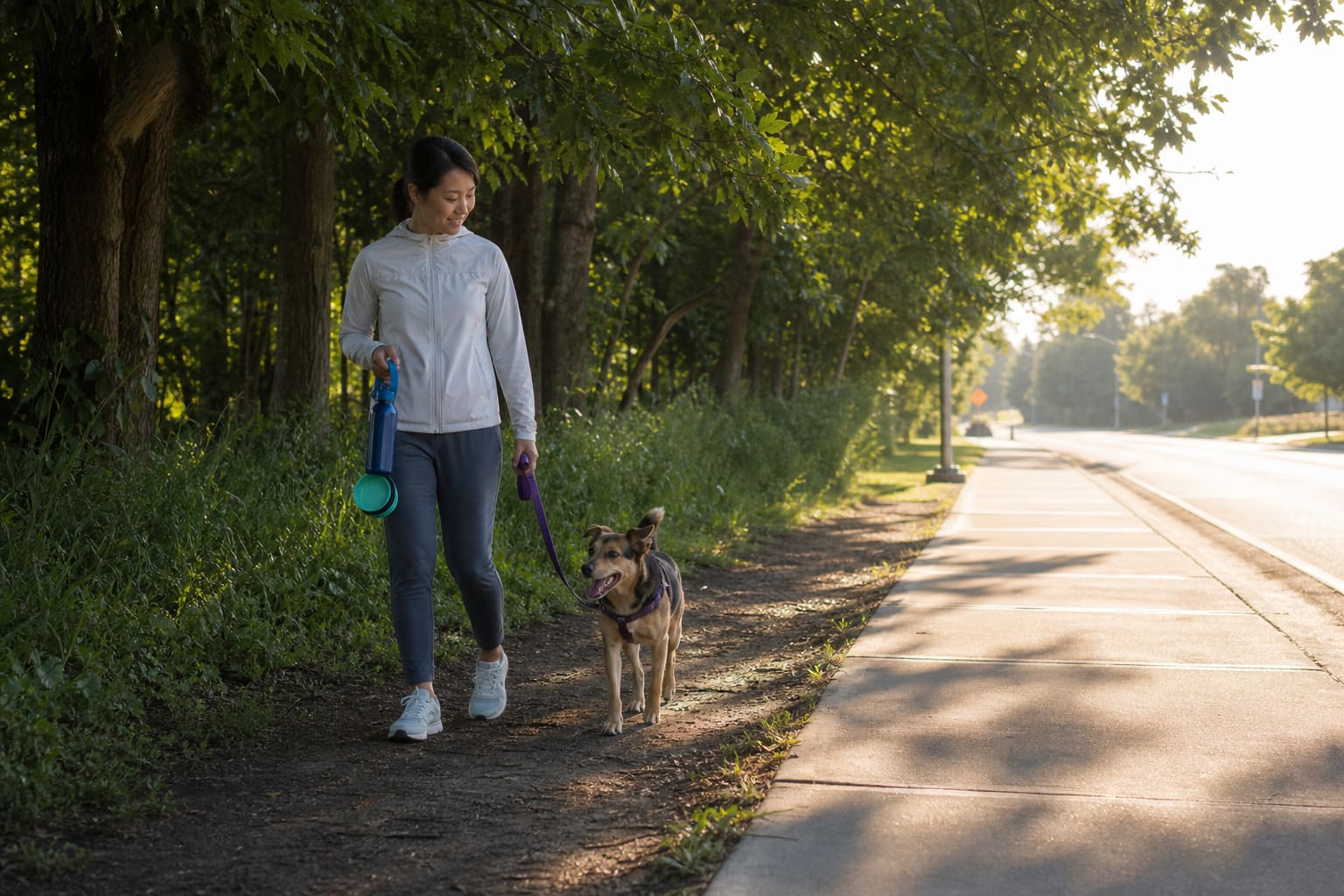
A treeless sidewalk in afternoon sun can be far more demanding than a shaded dirt path in the early morning. Walls, asphalt, parked cars, and artificial turf can radiate stored heat. Still air reduces convective cooling. Dark-coated dogs may absorb more solar radiation in direct sun.
Before leaving, look beyond the forecast:
- Is the entire route exposed?
- Where is the nearest deep shade?
- Can you choose grass instead of pavement?
- Is there a breeze?
- How quickly can you return to air conditioning?
- Will the route become hotter before you finish?
An out-and-back walk also needs a safety margin. Your dog must still have enough capacity to get home after the turnaround point.
Can hot pavement burn a dog's paws?
Yes. Pavement, asphalt, concrete, sand, metal, and artificial turf can become much hotter than the surrounding air and can injure paw pads.
The popular “seven-second hand test” can alert you that a surface is obviously hot, but it cannot certify that a route is safe. Human hands and canine paw pads do not experience heat identically, surface temperatures change across the route, and heat illness can occur even when the paws are protected.
Use the hand check only as one conservative screen:
- test both sunny and shaded sections
- choose grass or natural shade when possible
- avoid protective boots unless the dog is already comfortable wearing them and they do not add overheating risk
- never assume booties make a hot-weather exercise session safe
Turn back if your dog lifts paws, limps, refuses to move, repeatedly seeks grass, or begins licking the feet. Check pads for redness, discoloration, tenderness, blistering, or loose skin and contact a veterinarian if injury is suspected.
Dogs at higher risk in hot weather
Research on canine heat-related illness shows that risk is not distributed evenly. Use a more conservative plan for:
Flat-faced dogs
Brachycephalic dogs have shortened airways and can struggle to move air efficiently. This includes breeds such as Bulldogs, French Bulldogs, Pugs, Boxers, and similar dogs.
Older dogs and puppies
Older dogs may have reduced cardiovascular, respiratory, or mobility capacity. Puppies can overexert quickly and may not regulate activity well.
Overweight or unfit dogs
Extra body mass and low conditioning increase the work of movement and heat dissipation. A dog returning to exercise after inactivity should not use a hot day to rebuild fitness.
Thick-coated and large dogs
A dense coat can reduce heat transfer, and large body size is associated with greater heat-related illness risk in published veterinary research. Do not shave a double-coated dog as an emergency summer strategy without breed-appropriate grooming advice; coat function and regrowth vary.
Dogs with medical conditions
Heart disease, airway disease, seizure disorders, endocrine disease, mobility limitations, and some medications may change heat tolerance. Ask your veterinarian for an individualized summer-exercise plan.
Dogs that are not acclimated
A sudden hot spell can be harder than similar weather after gradual acclimation. Travel from a cool climate, recent adoption, illness, and weeks of indoor inactivity all matter.
Early signs a dog is getting too hot
Do not wait for collapse. End the walk when your dog shows a meaningful change from their normal response to exercise.
Early warning signs can include:
- unusually heavy or persistent panting
- excessive or thick drooling
- repeatedly seeking shade or water
- slowing down or lagging behind
- refusing to continue
- restlessness or difficulty settling
- bright red or unusually pale gums
- paw lifting or limping on hot surfaces
More serious signs include:
- weakness or poor coordination
- vomiting or diarrhea
- confusion or reduced responsiveness
- collapse
- seizures
Any suspected heatstroke needs veterinary attention. A dog that seems somewhat better after cooling can still have internal injury.
What to do if your dog may be overheating
Act immediately:
- Stop exercise. Move the dog into shade, air conditioning, or another cooler environment.
- Call a veterinarian or emergency clinic. Tell them you suspect heat-related illness and follow their transport instructions.
- Begin cooling. Apply cool—not ice-cold—water to the body and use airflow from a fan or moving air when available.
- Offer small amounts of water only if the dog is alert and able to drink. Do not force water into the mouth.
- Transport for veterinary care. Continue the clinic's recommended cooling plan on the way and do not delay because the dog appears to improve.
Avoid ice baths, wrapping the dog in wet towels that can trap heat, forcing water, or waiting to see whether severe signs pass.
How to walk a dog more safely in hot weather
Go at the coolest time
Early morning is often cooler than evening because pavement and buildings can hold heat after sunset. Check actual conditions rather than relying on the clock.
Shorten distance before slowing becomes necessary
Plan a loop close to home or an out-and-back route with early exits. A slow 10-minute sniff walk can provide useful activity without chasing the normal mileage.
Choose shade and natural surfaces
Tree cover and grass are usually preferable to exposed sidewalks, but inspect for hazards, ticks, broken glass, and local pesticide treatments.
Carry water
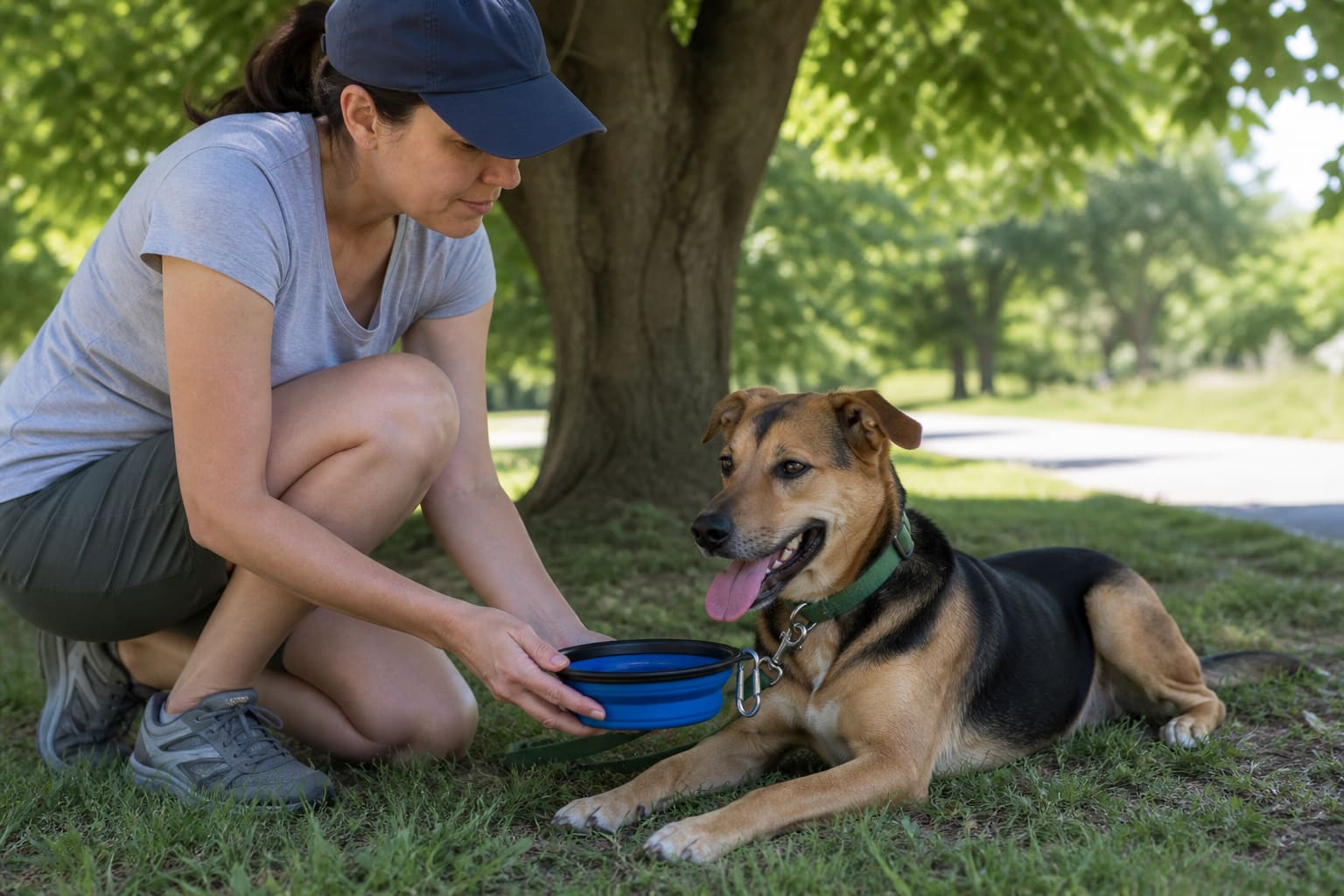
Bring potable water and a clean bowl. Offer brief opportunities to drink without forcing a large amount during exertion.
Remove intensity
Skip running, cycling, repetitive fetch, weighted equipment, and hard play. Excited dogs may continue working after they should stop.
Let the dog set a conservative pace
Sniffing and slow exploration can replace distance. Do not pull a slowing dog forward. If leash tension is making calm short walks difficult, use the reward-based plan in how to stop dog pulling on leash during cooler practice sessions.
Never leave a dog in a parked vehicle
Shade, cracked windows, and a short errand do not make a parked car safe in warm weather. Leave the dog at home unless continuous climate control and direct supervision are guaranteed.
Indoor exercise when it is too hot to walk
Skipping one hot-weather walk does not mean skipping all activity. Match the substitute to your dog's health, food allowance, mobility, and arousal level.
Useful options include:
- a short find it game
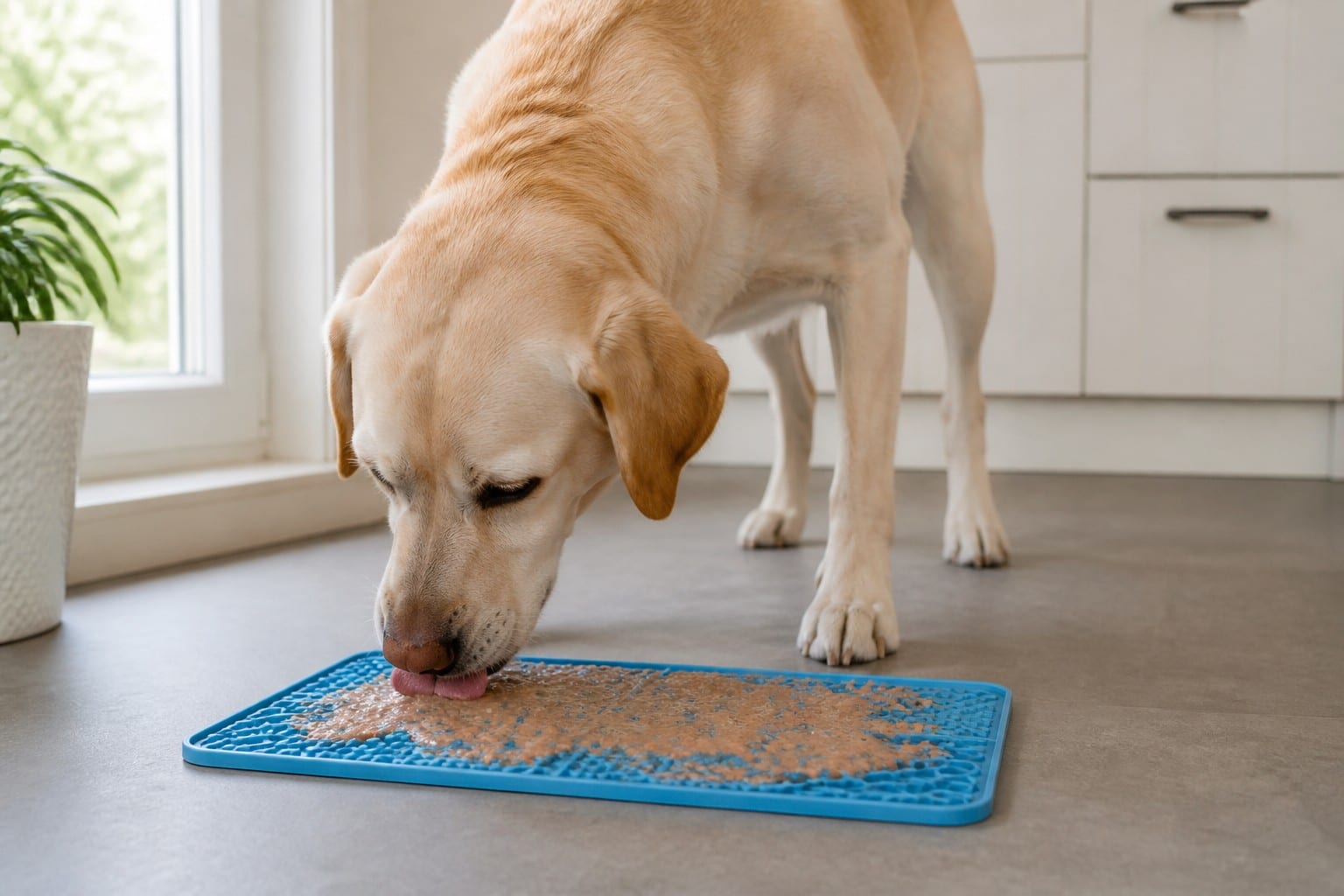
- measured food in a snuffle mat
- two-minute training sessions with rest between them
- gentle toy play on a nonslip floor
- supervised cardboard-box enrichment
- low-impact ideas from rainy day dog enrichment
Keep indoor activity moderate if your home is also warm. Mental work does not need to become an exhausting marathon.
A 60-second pre-walk heat check
Before every warm-weather outing, ask:
- Weather: What are the temperature, humidity, sun, wind, and local warnings?
- Dog: Is my dog high-risk, already panting, unwell, tired, or unacclimated?
- Surface: Is the route shaded, and have I checked the actual ground?
- Plan: Can I cut the distance, slow down, carry water, and return quickly?
- Alternative: Would a brief potty trip plus indoor enrichment be safer today?
If two or more answers concern you, change the plan. Dogs do not lose meaningful fitness because one unsafe walk became a scent game indoors.
FAQ
What temperature is too hot to walk a dog?
There is no universal cutoff. Around 80°F (27°C), many dogs need shorter, shaded outings, and high-risk dogs may need to skip exercise. Humidity, direct sun, pavement, workload, and individual health can make lower temperatures dangerous too.
Is 75°F too hot to walk a dog?
Not automatically, but 75°F (24°C) in high humidity and direct sun can be challenging, particularly for flat-faced, older, overweight, unfit, thick-coated, or medically vulnerable dogs. Check the full conditions and shorten the plan.
Is 80°F too hot to walk a dog?
It can be. Choose the coolest time, deep shade, a short route, and a gentle pace. For a high-risk dog, use a brief potty trip and indoor activity instead.
Is 90°F too hot to walk a dog?
Routine exercise walks at 90°F (32°C) are unsafe for many dogs. Use only brief essential outings during the coolest available conditions unless your veterinarian has provided a specific plan.
How do I know if pavement is too hot?
Check both sunny and shaded surfaces. If the ground is uncomfortable for your hand, avoid it, but remember that a hand test cannot prove safety. Watch the dog and favor cool grass and shade.
What are the first signs of heatstroke in dogs?
Heavy panting, excessive drooling, slowing, shade-seeking, weakness, poor coordination, vomiting, diarrhea, confusion, or collapse are concerning. Stop exercise, begin safe cooling, and contact a veterinarian immediately.
Sources
- Cornell University College of Veterinary Medicine: Heatstroke—A Medical Emergency
- VCA Animal Hospitals: Heat Stroke in Dogs
- American Veterinary Medical Association: Warm Weather Pet Safety
- Scientific Reports: Dogs Don't Die Just in Hot Cars—Exertional Heat-Related Illness in UK Dogs
- U.S. National Weather Service: Heat Index